Sony's New AI Patent Predicts Button Presses Using Finger-Camera Tech
Author: Mia
Apr 17,2025


Sony has recently filed a patent that could revolutionize how the company tackles latency in future gaming hardware. Dubbed WO2025010132, titled "TIMED INPUT/ACTION RELEASE," this patent focuses on minimizing delays between a user's input and the game's response, ensuring a more seamless and responsive gameplay experience. This move comes as Sony continues to innovate with technologies like the PlayStation Spectral Super Resolution (PSSR) introduced with the PlayStation 5 Pro, which upscales smaller resolutions to 4K but can introduce latency issues, especially when used alongside newer graphics technologies such as frame generation.
Latency has been a significant concern in gaming, often leading to a less responsive feel despite the addition of extra frames. Both AMD and Nvidia have attempted to address this issue with their respective Radeon Anti-Lag and Nvidia Reflex technologies. Sony's approach, as outlined in the new patent, involves using a sophisticated machine-learning AI model that predicts the next input a player will make, coupled with external sensors like a camera focused on the controller to anticipate button presses.
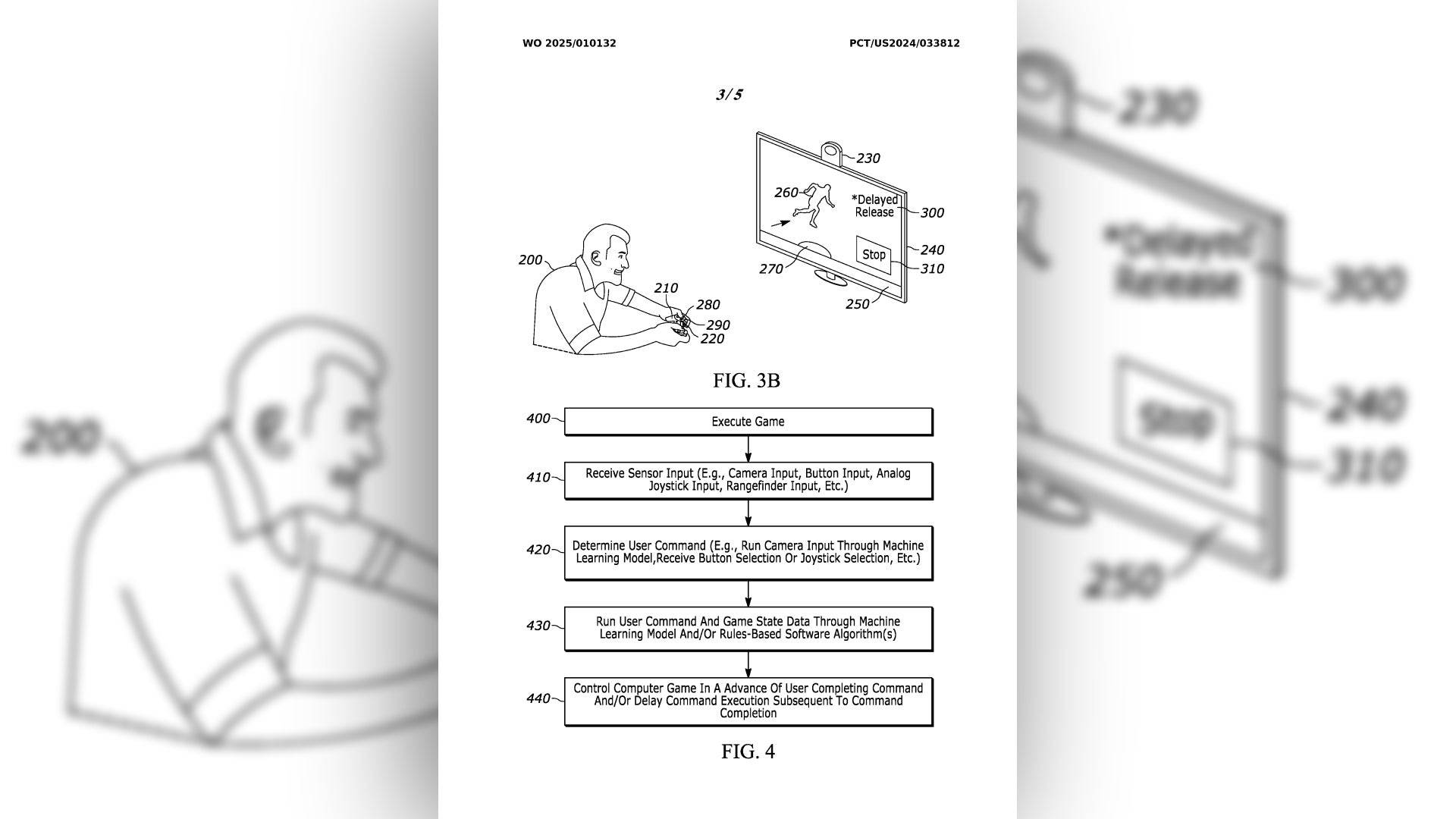
According to the patent, Sony's system aims to streamline the "timed release of user commands." The company explains that "there can be latency between the user's input action and the system's subsequent processing and execution of the command," which can lead to delayed and unintended consequences in the game. To combat this, Sony proposes using camera input as part of the machine learning model to predict the first user command accurately.
The patent also hints at the possibility of using sensors within the controller itself, potentially leveraging analog buttons—a feature Sony has previously championed. While it's uncertain if this exact technology will appear in the PlayStation 6, the filing indicates Sony's commitment to reducing latency without compromising the responsiveness of games, especially in light of popular rendering technologies like FSR 3 and DLSS 3 that can introduce additional frame latency.
This innovation could particularly benefit genres like twitch shooters, where high framerates and minimal latency are crucial for competitive play. Whether this patent will translate into tangible improvements in future Sony hardware remains to be seen, but it's clear the company is actively seeking solutions to enhance the gaming experience.