

LetsView : mettez en miroir sans effort votre écran sur votre téléviseur
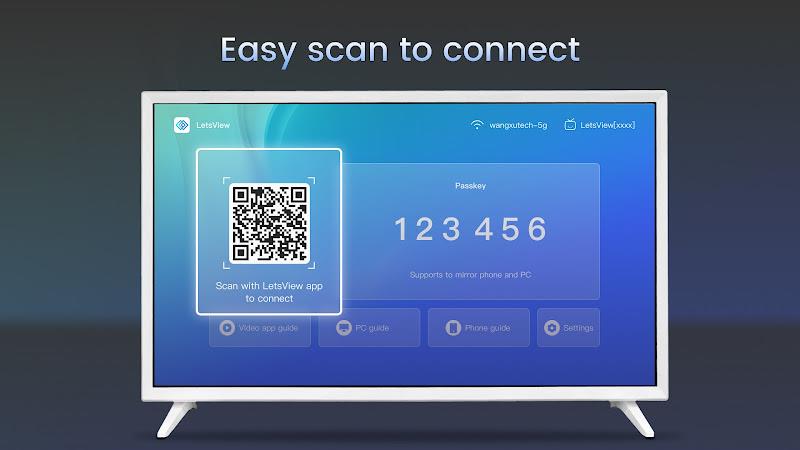
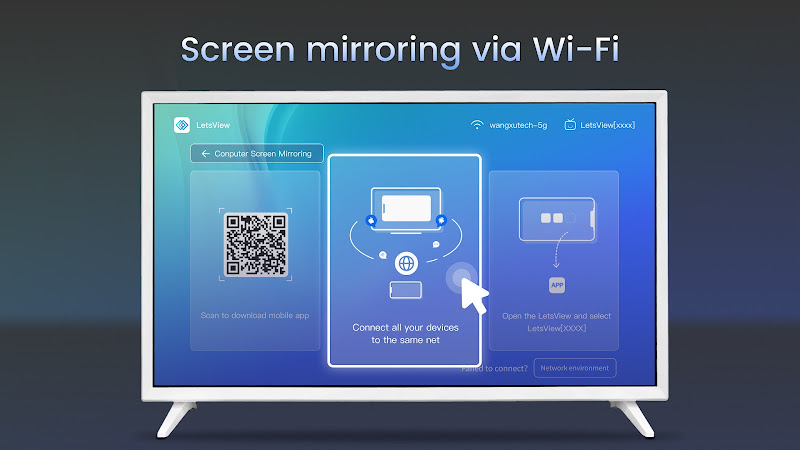
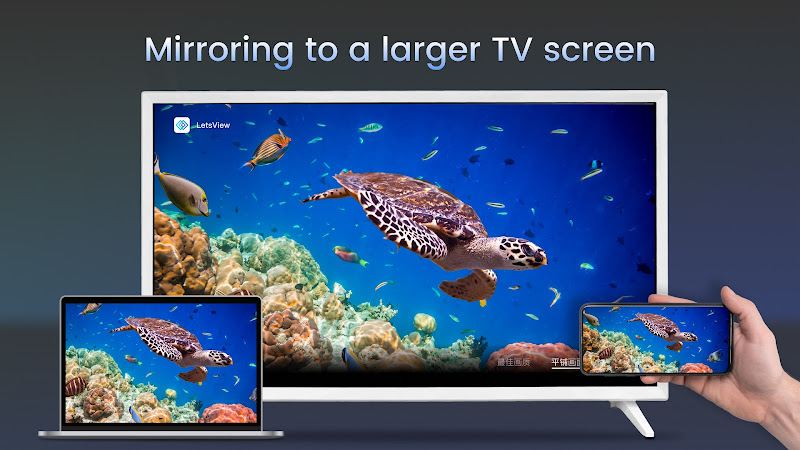
LetsView est une application de mise en miroir d'écran conviviale permettant un affichage transparent de l'écran de votre téléphone mobile ou de votre ordinateur sur votre téléviseur. D'un simple clic, vous pouvez mettre en miroir votre téléphone, votre tablette ou votre ordinateur sur votre téléviseur, simplifiant ainsi le partage de contenu avec vos amis et votre famille.
Au-delà de la mise en miroir de base, LetsView propose une gamme de fonctionnalités :
-
Mise en miroir complète : Mettez en miroir les écrans de votre téléphone, de votre tablette et de votre ordinateur sans effort, facilitant ainsi le partage de contenu.
-
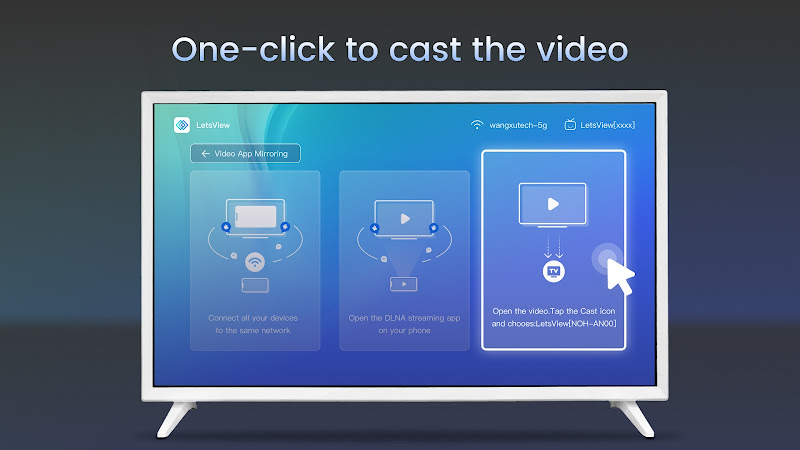
Diffusion vidéo polyvalente : Diffusez des vidéos depuis des appareils Android, iOS ou toute application compatible DLNA directement sur votre téléviseur, élargissant ainsi vos options de divertissement.
-
Jeux mobiles immersifs : Profitez du streaming de jeux mobiles haute résolution sur votre téléviseur, créant une expérience visuelle captivante parfaite pour partager le jeu.
-
Diffusion de musique haute fidélité : Diffusez de la musique depuis votre appareil mobile ou votre ordinateur sur votre téléviseur et plongez-vous dans une expérience de son surround.
-
Présentations simplifiées : Présentez sans effort des documents (PPT, PDF, Word, Excel, etc.) depuis votre téléphone, ordinateur ou tablette sur votre téléviseur.
-
Fonctionnalité de contrôle à distance : Une fois la mise en miroir, contrôlez la lecture de votre téléviseur (lecture/pause, volume, retour/avance rapide) directement depuis votre appareil mobile.
LetsView est une application puissante mais intuitive offrant la mise en miroir d'écran, le streaming vidéo, les jeux mobiles, la diffusion de musique, des capacités de présentation et des fonctionnalités de contrôle à distance. Compatible avec les téléviseurs intelligents fonctionnant sous Android 5.0 et supérieur, LetsView améliore votre expérience télévisuelle. Téléchargez-le aujourd'hui !
Letsview TV : diffuser l'écran Captures d'écran
Poster des commentaires
-
1、Taux
-
2、Commentaire
-
3、Nom
-
4、E-mail
"Wittle Defender" sounds like a fresh and exciting fusion of genres—tower defense, roguelike, and card-based mechanics! Here's a breakdown of how these elements could seamlessly blend together to create a compelling and addictive gameplay loop:
🎮 Game Concept: "Wittle Defender"
A rogue-lite tower defense game where every battle is shaped by a unique deck of cards, and no two runs are the same.
🛡️ Core Gameplay Loop:
Card-Driven Tower Placement
Instead of buying towers with gold, you play cards to place defensive structures.
Each tower (e.g., Archer, Cannon, Mage, Trap) is represented by a card with a unique cost, effect, and upgrade path.
Example: Play a "Fireball Tower" card to summon a tower that explodes on enemy contact—but it costs 3 mana and can’t be placed near other explosive structures.
Procedural Runs (Roguelike)
Each wave is procedurally generated with randomized enemy types, paths, and objectives (e.g., "Defend for 5 minutes," "Survive 10 waves with no towers destroyed").
After a run ends (you’re defeated or complete the goal), you return to a "Sanctuary" hub and spend "Legacy Points" (earned from previous runs) to unlock new cards, abilities, and passive upgrades.
Permadeath is in effect—fail a run, but unlock powerful upgrades for the next.
Deckbuilding & Strategic Depth
Before each run, build a custom deck from a pool of 10–15 cards (including towers, abilities, and "Field Effects" like "Poison Cloud" or "Gravity Well").
Cards have synergy: Playing a "Snare" card and a "Slow" card together creates a devastating trap zone.
Limited hand size (e.g., 5 cards) forces tough decisions—do you focus on offense, defense, or utility?
Dynamic Enemy Evolution
Enemies adapt to your strategy—e.g., if you overuse fire towers, enemies get fire resistance.
Bosses appear after every 3rd wave, and they’re also influenced by your deck—some may be immune to certain elements, forcing you to rethink your strategy mid-run.
Ascension & Progression
Unlock new "Archetypes" (e.g., "The Stormcaller," "The Engineer") that alter your deck-building rules and style.
Each archetype has a unique passive (e.g., "All cards cost 1 less mana per 3 enemies killed").
Over time, you unlock "Mythic Cards" that can only be used once per run but turn the tide of battle.
🔥 Unique Features:
"Wittle" Power Ups: After every 3 waves, you draw a "Wittle Favor" card—random perks like "All towers shoot 1 extra time," "Recycle 1 card from discard pile," or "All enemies take 20% more damage for 30 seconds."
Environmental Cards: Use terrain cards like "Ice Slide" or "Lava Rift" to control enemy movement and create choke points.
Deck Mastery: As you play, you unlock "Card Mastery" levels. Mastering a card reduces its cost and adds a passive effect (e.g., "This tower gains +1 range when you play 3 cards in a row").
🎯 Why It Works:
Short Runs, High Replayability: Each game lasts 10–20 minutes, perfect for mobile or casual play, but deep enough for hardcore fans.
Strategy Meets Chaos: The roguelike structure keeps you on your toes, while card mechanics let you experiment and grow stronger over time.
Unique Identity: Blends the precision of tower defense, the tension of roguelikes, and the creativity of card games into a tight, satisfying package.
📌 Tagline Suggestion:
"Build your deck. Defend the wittle. Survive the chaos."
If you’re developing this, consider a stylized, quirky art style (think Mini Metro meets Slay the Spire with a dash of Plants vs. Zombies). Sound design should be playful but tense—card draws with a "snap," enemy hits with a crack, and victory music like a triumphant jingle.
Would you like help designing a sample deck, enemy types, or a level progression system? 🃏🛡️🔥